www.friendsofwater.com www.shop.friendsofwater.com 
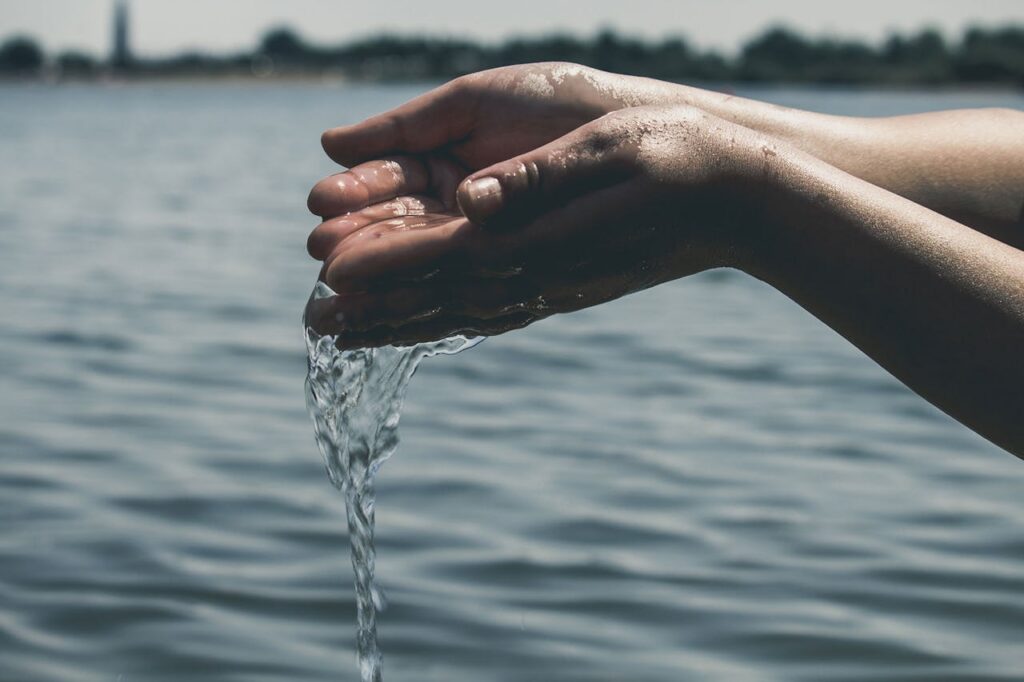
Baptism Recently we attended the baptism of two beautiful children. They blessed us with their presence and we blessed them and their appearance among us. The use of water to purify and bless, and to welcome a child into a religious community seems an ancient tradition. We say we are earth and we will return to earth, but in truth we are mostly water. As most of our earth is covered with water.
 Jordan River
Christianity It seems that Baptism is most frequently associated with Christian churches, where the ceremony is used to bring someone into the church community. In some Christian churches this is done primarily with infants or new members, in others with adults. Baptism as practised by John the Baptist and other early Christians was not something new. It was a continuation of the ancient Jewish tradition of ritual bathing. While there was disagreement about that previously, the discovery and reading of the Dead Sea Scrolls has made it clear this ritual bathing did exist in Jewish tradition prior to Christ.

Mormon Because of their understanding that baptism is essential for salvation, and that God is merciful - but knowing that many have died without baptism, the Church of Jesus Christ of Latter Day Saints performs proxy baptisms on behalf of deceased ancestors. Individuals can then choose to accept or reject what has been done on their behalf.

Historical Mayan Michael D. Coe, the eminent scholar of the Maya, noted baptism in his book, The Maya. "Immediately after birth, Yucatecan mothers washed their infants and fastened them to a cradle. . . . As soon as possible, the anxious parents were to consult with a priest so as to learn the destiny of their offspring, and the name which he or she was to bear until baptism. "Major Mayan ritual was associated with being born again, purification, cleansing from sin, confession of sins to a priest, changing one's nature to be a better person, and gaining salvation in the afterlife." In the book An Illustrated Dictionary of the Gods and Symbols of Ancient Mexico and the Maya by Dr. Mary Miller and Dr. Karl Taube is a part called "Baptism". Here is an excerpt. "When the first Spanish priests arrived in New Spain, they were surprised to find native forms of baptism, in this case the ritual bathing of infants and children. In Yucatan, according to Diego de Landa, a native priest sprinkled male and female children of approximately three years of age with water from a serpent-tailed aspergillium. In addition, one of the principal citizens of the community anointed the children with water from a moistened bone. Landa notes that this rite cleansed and purified the children, an important function of baptism. "Book 6 of the Florentine Codex provides detailed descriptions of the ritual speech and rites associated with Aztec baptism. In contrast to the Yucatec ceremony, baptism took place soon after birth. However, the Aztec rite was also associated with purification, to remove any pollution acquired from the parents. During the ritual bathing, the infant was named and presented with the tools necessary for adult life."
 The following excerpt from Veytia is taken from pages 167-169 of Ancient America Rediscovered: "Although it varied in the ceremonies according to the places, substantially they all agreed on this bath of natural water, saying upon the baptized person some forms such as honors and prayers and putting a name upon him, and this they observed as a rite of religion, preserving the memory of Quetzalcohuatl's having taught it to them.
Chinese I Ching Among the hexagrams in the I Ching is the one entitled Ko, and it's described by the phrase "Fire in the lake: the image of revolution." Fire in water—a Confucian image for a moment of truly dramatic change in life. This is comparable to the Christian understanding that Jesus baptizes people not only with water but also with fire and the Spirit. That is, baptism is with an inflaming, purifying, grace-laden outpouring of God's Holy Spirit.

Excerpts From the Writings of Paramhansa Yogananda (Author of Autobiography of a Yogi) from East West 1932 "Intuitional Interpretation of Yogoda, Hindu, and Christian Baptism" "The original ceremony of baptism by water came from India. Baptism means immersion in water in order to cleanse or purify. Purification of the body should precede the purification of the mind. Hence, all souls who desired to begin living the spiritual life had to purify their bodies. "Cleanliness is next to Godliness," but baptism of the body, unless followed by baptism of the mind, becomes practically meaningless. If we bathe and thus purify our bodies, we will find that our mind will temporarily become purified, but unless we change our souls' wickedness by calmness and meditation, and constant spiritual vigilance, we will remain the same old devils with bad habits in spite of the temporary purifying effect of the water on our bodies.
"It must be remembered, however, that bodily baptism by water has its good points. The custom in India is to take spiritual lessons from a holy man only immediately after bathing. To take spiritual lessons with a sweaty, unclean body is not effective. The Baptists do well to immerse their initiates in water, but the ceremony of immersion without following it up with continued spiritual lessons in meditation and God—contact is of little value."

Particularly helpful in the research for this article was the follow web page: http://www.jefflindsay.com/LDSFAQ/FQ_Baptism.shtml#water |